
How to use Layback X
From the first screen to cashing out: where the markets are, how the ladder works, how to bet and how to set it all up your way.
What Layback X does
Polymarket sells shares of outcomes: you buy “Yes” at 70¢ and, if you are right, each share is worth 1 USDC. That is a correct way to show price, but it is not how an exchange bettor thinks.
Layback X translates that into what you already know: decimal odds, one-click back and lay, liquidity stacked on a ladder, traded volume by price, P&L per runner and cash out. 70¢ becomes odds 1.43, the same market, in the language of someone who trades sports exchanges.
The main window has four areas in the sidebar: Home, Sports, My Bets and Settings. Each market you open gets its own window, so you can stack as many as you like across displays.
Finding markets
There are two routes, and they serve different purposes: Home to sweep everything Polymarket has, Sports to go straight to games.
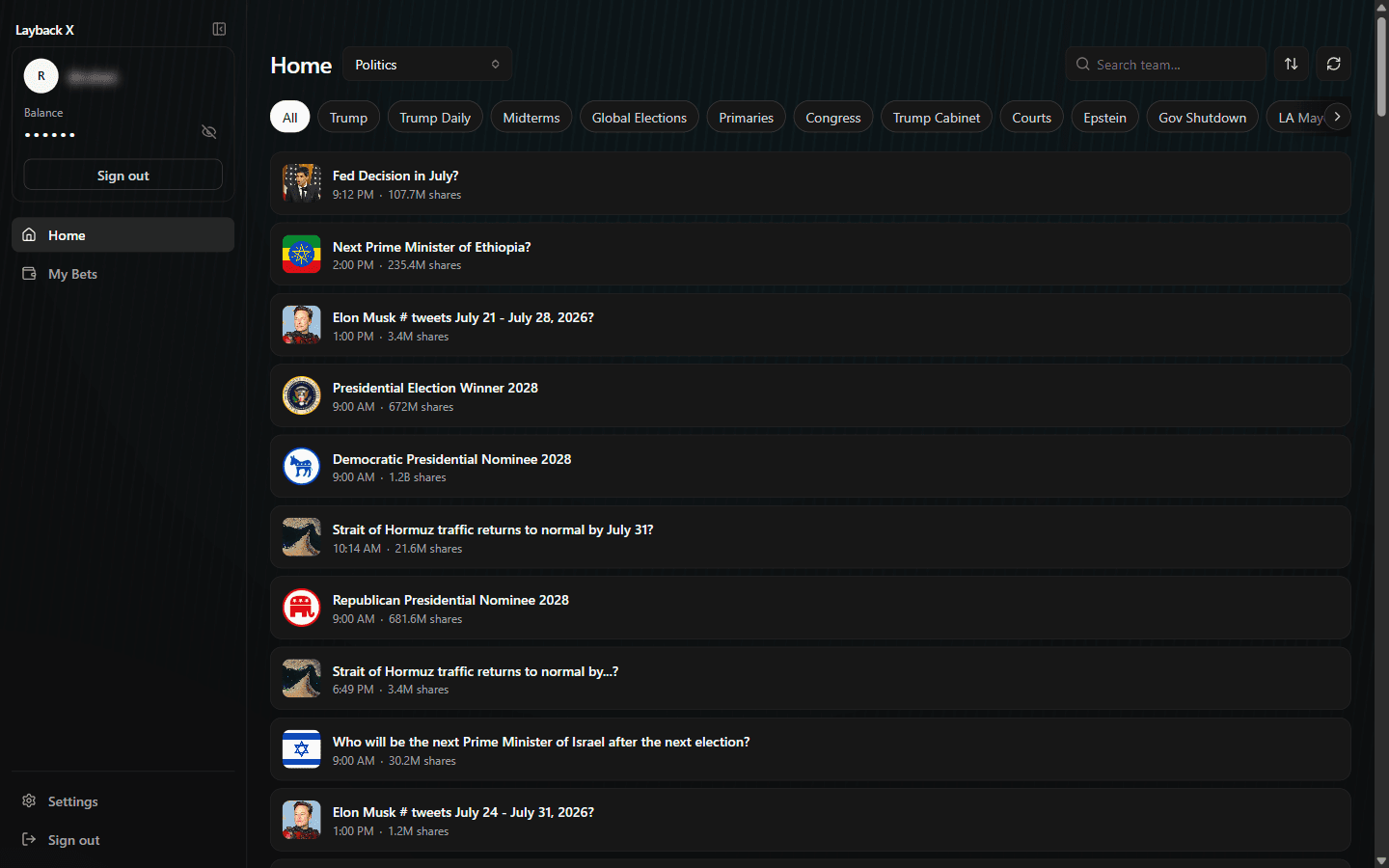
Home: by area
In Home you pick an area, the top-level theme, and browse inside it. The areas are Politics, Sports, Crypto, Finance, Geopolitics, Earnings, Tech, Culture, World, Economy, Climate & Science and Elections.
Inside an area you get sub-areas as chips, and when the area is Sports you also get sport chips (Soccer, Basketball, American Football, Baseball, Ice Hockey, Tennis, E-sports) plus a Championship filter, with type-to-filter for when the list is long.
Sports: games and futures
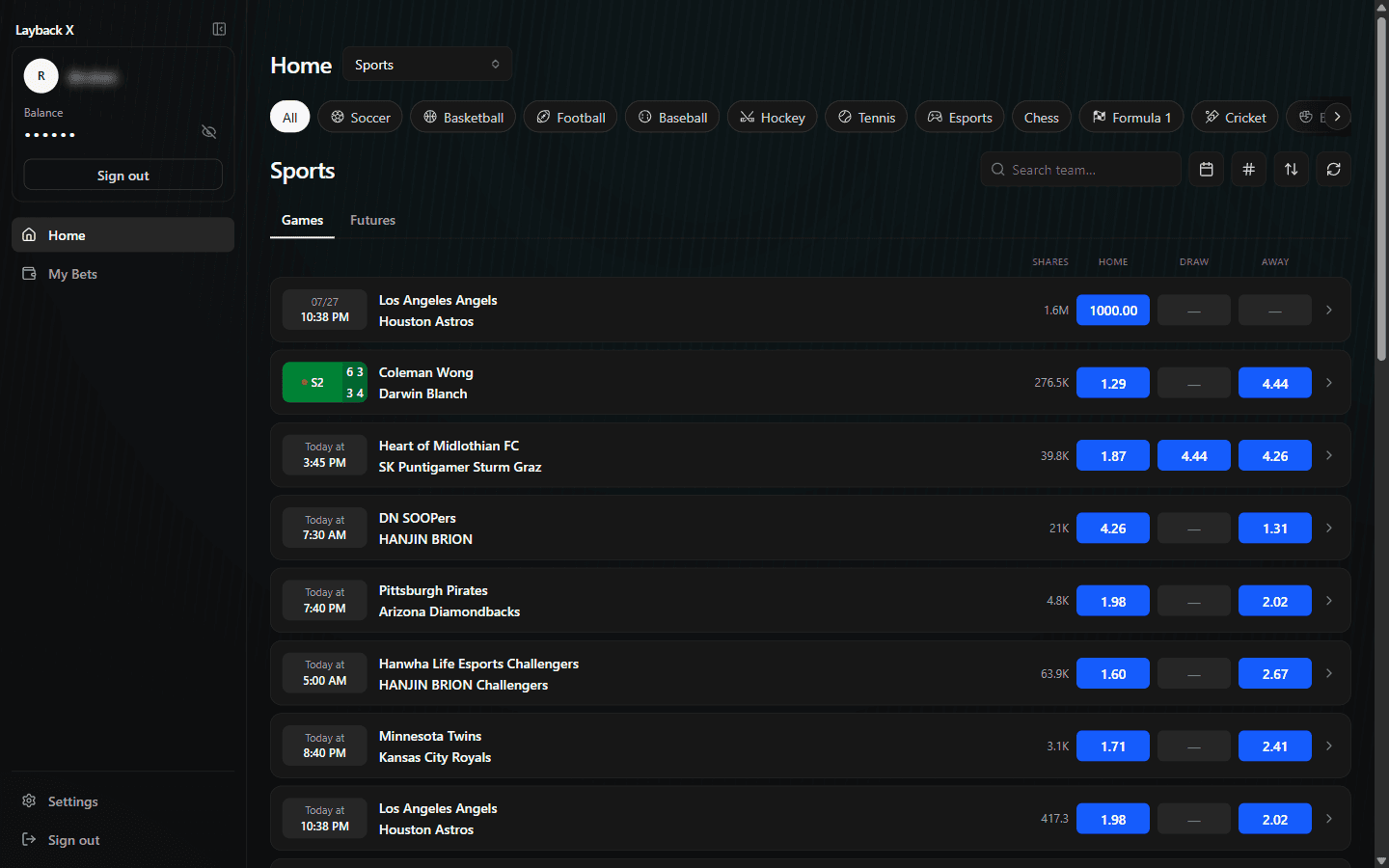
Sports has two tabs. Games lists fixtures with kick-off times, in columns Home, Draw, Away and Contracts. Futures holds season-long markets with no head-to-head: winner, qualification, top scorer.
You filter by day (All, Today, Tomorrow or a date), sort by 24h volume, total volume, liquidity, start date or end date, and search a team by name. Searches ignore the chosen sort and come back by relevance. Live games get a LIVE badge, and you can favourite championships to keep them at the top.
Clicking a game opens that fixture's market panel, grouped: Moneyline, Spreads, Totals, period markets (first and second half), Correct score, Both teams to score, Double chance, corners, penalties, extra time, qualification, plus the per-quarter equivalents in basketball and per-inning in baseball. Picking a group opens its ladder.
The ladder
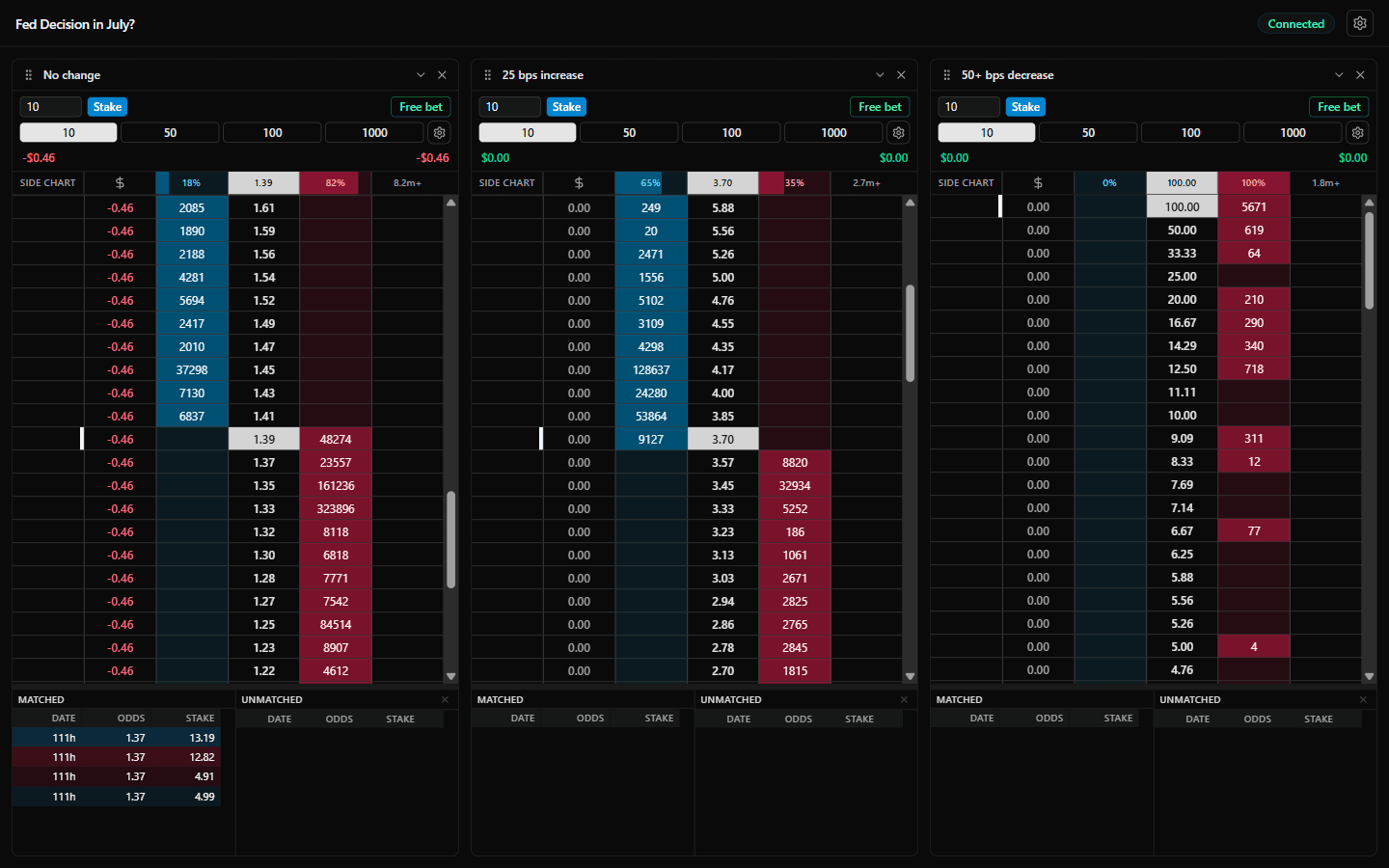
Each market opens in its own window. Inside it there is one ladder per runner, each possible outcome: “Home”, “Draw”, “Away”, “Yes”, “No”. They sit side by side, and you drag them by the handle at the top to reorder, close the ones you do not need and reopen them from the runner selector.
At the top of the window you get the market state (Live, Suspended or Closed) and the feed state: Connected, Reconnecting or Disconnected. Worth a one-second glance before betting: a suspended market takes no orders, and a reconnecting feed means the prices on screen may be stale.
The columns
| Column | What it shows |
|---|---|
| Back | Money available for you to bet on the runner at that odds. Clicking places the bet. |
| Price | The odds. The only mandatory column, and the only one that never abbreviates values. |
| Lay | Money available for you to bet against the runner at that odds. |
| Traded | How much has traded at each odds, in USDC. Shows where the market actually went. |
| P&L | Your result on that runner if the market settles at that odds. Toggles between value and percentage. |
The column order is yours: drag them on the Columns tab of the ladder settings. You can also hide the ones you do not use, except Price.
The Back and Lay headers show the weight of money: the share of liquidity on each side, as a percentage. Read it as pressure, not as probability.
Beside the ladder there is a side chart with the price movement. And the centre button jumps to the last traded price, handy after you have scrolled the ladder looking at far-off odds.
Placing bets
Betting is clicking a cell: Back to bet the runner happens, Lay to bet it does not. The odds are the row you clicked, and the amount is whatever is in the stake field.
Hovering a cell, the position readout already shows what that bet would do to your result: green is profit if the runner wins, red is loss if it loses. You can check before clicking.
Amount: stake, liability or profit
The amount field has three modes, and the button beside it cycles through them:
- Stake: you set how much you risk. The return varies with the odds.
- Liability: you set the maximum loss. Useful on lay bets, where risk grows with the odds.
- Profit: you set how much you want to win, and the app works out the amount to bet.
Next to it are the stake presets: from 1 to 8 fixed-value buttons that you define, reorder by dragging and use with one click. That is what lets you bet at live-game pace without typing.
How the click fires
In the ladder settings you choose the bet trigger, and this is the setting that changes the feel of the app the most:
| Mode | When it bets |
|---|---|
| Single click | On mouse release. The default balance. |
| Fast click | On press, without waiting for release. The fastest and the least forgiving. |
| Double click | Only on the second click. Guards against a stray click. |
| Confirmation dialog | Opens a dialog with side, price and amount for you to confirm. |
There is also drag to bet: press a Back or Lay cell and drag to bet at every odds you pass. It works only in Single click and Fast click modes, and there is a cap on how many odds one drag can take, so a wide drag does not silently become ten bets.
Managing your position
Below each ladder sits the bets panel, with your bets on that runner split into Matched and Unmatched. Matched found a counterparty and is already a position; unmatched is still queued and can be cancelled.
Each row shows date, odds and stake, with a button to cancel that bet and another to cancel every unmatched bet on the runner. You drag the panel's top edge to resize it, or switch the panel off in settings and give the space back to the ladder.
Cash out
Cash out closes the position before the result, betting the other way to lock in what you have, profit or loss. There is per-runner cash out and cash out all, which does it across every runner at once.
Freebet is the other side of the same idea: instead of levelling the result, it leaves the position with profit if the runner wins and zero if it loses.
When Polymarket refuses
Every refusal shows as a notice in the window, with the reason. The ones you will see most:
| Notice | What to do |
|---|---|
| Insufficient balance | Deposit on Polymarket or bet less. |
| Your balance is held in bets | You have balance, but it is reserved in queued orders. Cancel some. |
| Below this market's minimum | Increase the bet amount. |
| This market doesn't accept those odds | The odds do not land on a valid increment for that market. Use a neighbouring row. |
| Polymarket isn't authorised to use your balance | Open the account panel and click Enable trading. |
| You already have this same bet queued | Nothing was duplicated. Check the bets panel. |
Keyboard shortcuts
Every shortcut is configurable and can be switched off one by one, on the Shortcuts tab of the ladder settings. Click a shortcut, press the new key; if it is already in use, the app tells you.
| Action | What it is for |
|---|---|
| Cancel all bets | Clears the window's whole queue. The panic key. |
| Cancel all Back | Only unmatched back bets. |
| Cancel all Lay | Only unmatched lay bets. |
| Cash out all | Closes positions across every open ladder. |
| Centre all ladders | Snaps them all back to the last traded price. |
| Cycle stake mode | Cycles stake, liability and profit. |
| Stake / liability / profit mode | Jumps straight to one mode, without cycling. |
| Next and previous stake preset | Changes the amount without leaving the keyboard. |
| Minimise window | Gets the market window out of the way. |
Ladder settings
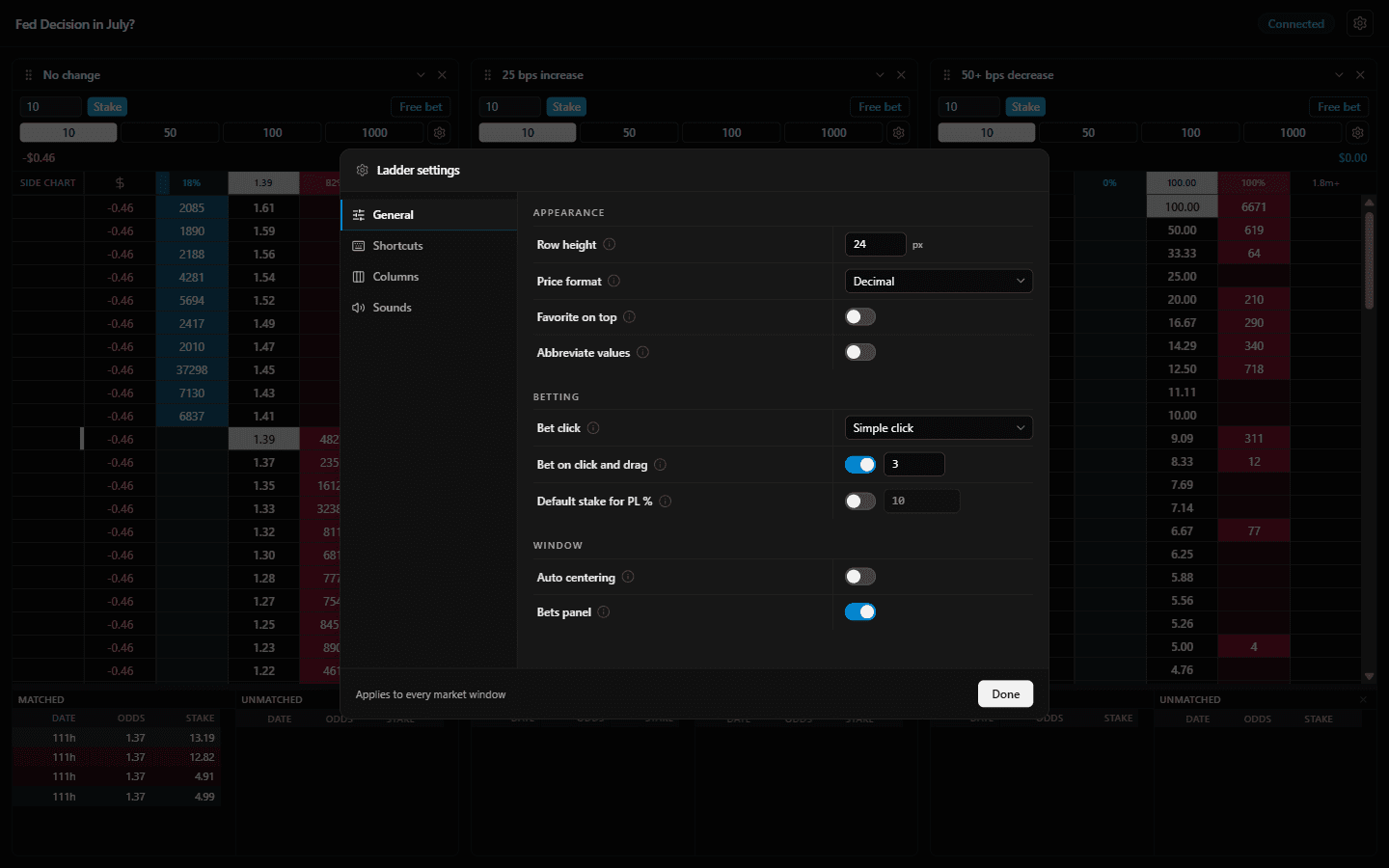
The settings button inside the market window opens four tabs: General, Shortcuts, Columns and Sounds. Everything here applies to all market windows, not just the one in front of you.
General
| Setting | What it does |
|---|---|
| Price format | The unit of the Price column: decimal, ¢, percentage, fractional or American. |
| Row height | From 16 to 48 pixels. Short rows show more odds; tall rows misclick less. |
| Auto centre | Recentres when the last traded price scrolls off screen. Pauses while your cursor is over the ladder, so it never moves out from under your click. |
| Favourite on top | Off, the highest odds sit on top. On, the favourite sits on top. |
| Abbreviate values | Back, Lay, Traded and the bet in the Price cell switch to 1.6k and 1.2m. The Price column never abbreviates. |
| Inverted back and lay liquidity | Off, each column shows the money resting on its own side. On, it shows what that side can take right now. The side you bet does not change. |
| Drag to bet | Enables dragging, with a cap on how many odds one drag takes. |
| Fixed stake for P&L % | On, the percentage divides by one fixed stake across every market. Off, it divides by the risk of each runner's first matched bet. |
| Bets panel | Shows or hides your bets below each ladder. |
Columns and Sounds
On Columns you drag to reorder and switch each one on or off, with a preview beside it showing the result before you close. Price is mandatory.
On Sounds you pick a sound for four events (Bet placed, Bet cancelled, Bet matched and Market suspended) with variants to try and the option to mute each one. The matched sound is the one that helps most: you know you got filled without looking at the panel.
My Bets
This is the whole-account view, regardless of which market windows you have open. The header shows Bankroll (the account total), Available (what is not tied up in bets) and Open P&L (the result of positions that have not settled).
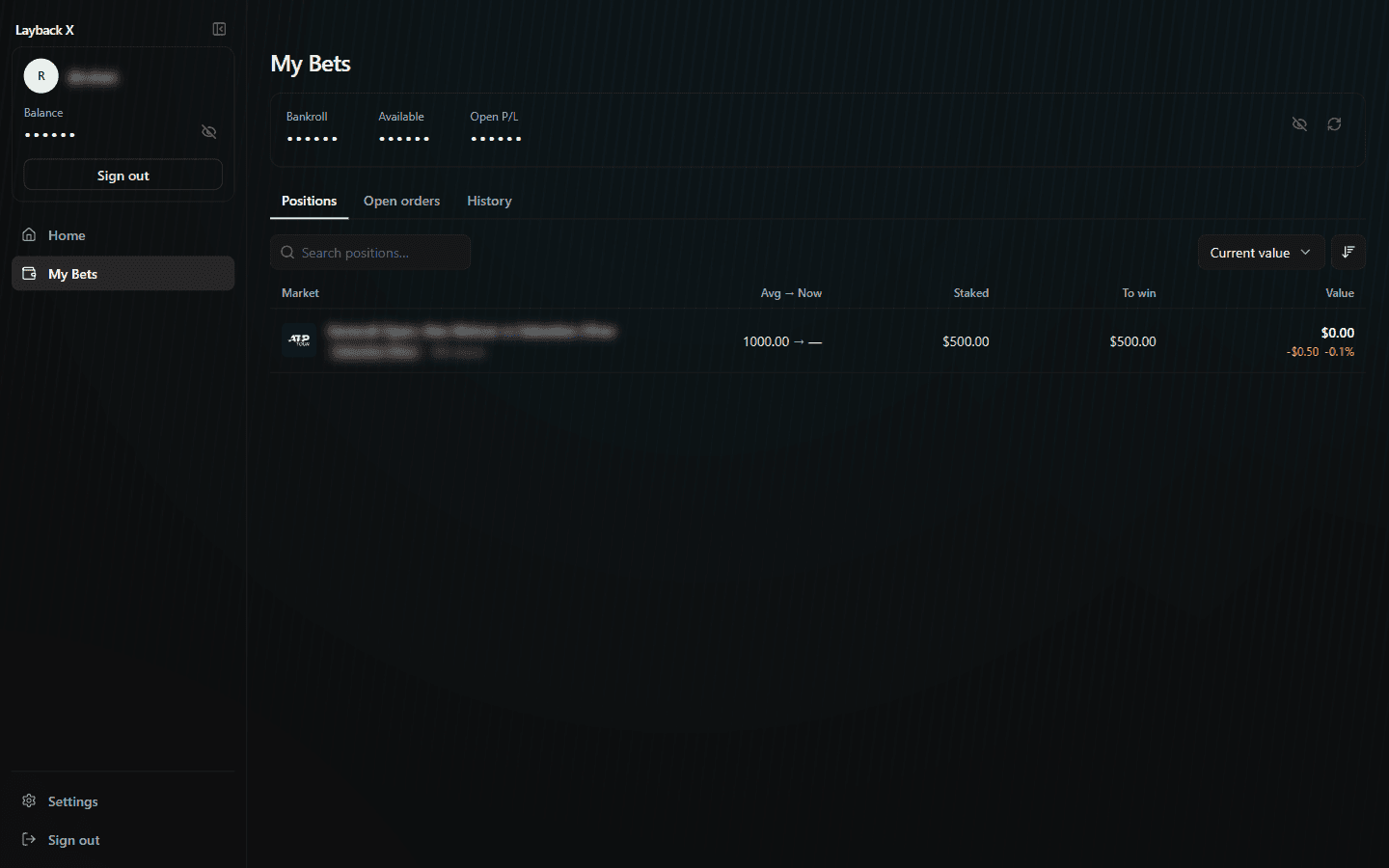
Positions, Open orders and History
- Positions: what you hold, with Avg → Now (your average price against the current one), Invested, To win and Value. Clicking a row opens that market on a ladder.
- Open orders: bets still queued, with side, price, how much has filled, total and expiry (Until cancelled, mostly). Cancel them one by one or all at once.
- History: the account statement, by movement type.
All three tabs have search over what is already loaded, sorting and Load more. History filters by period (today, 7 days, 30 days or chosen dates) and by group: buys, sells, deposits, withdrawals, redemptions, rewards and structure.
The types you will see in history: Trade, Buy, Sell, Split, Merge, Win, Loss, Reward, Conversion, Deposit, Withdrawal, Yield, Maker rebate, Taker rebate and Referral reward.
Preferences and privacy
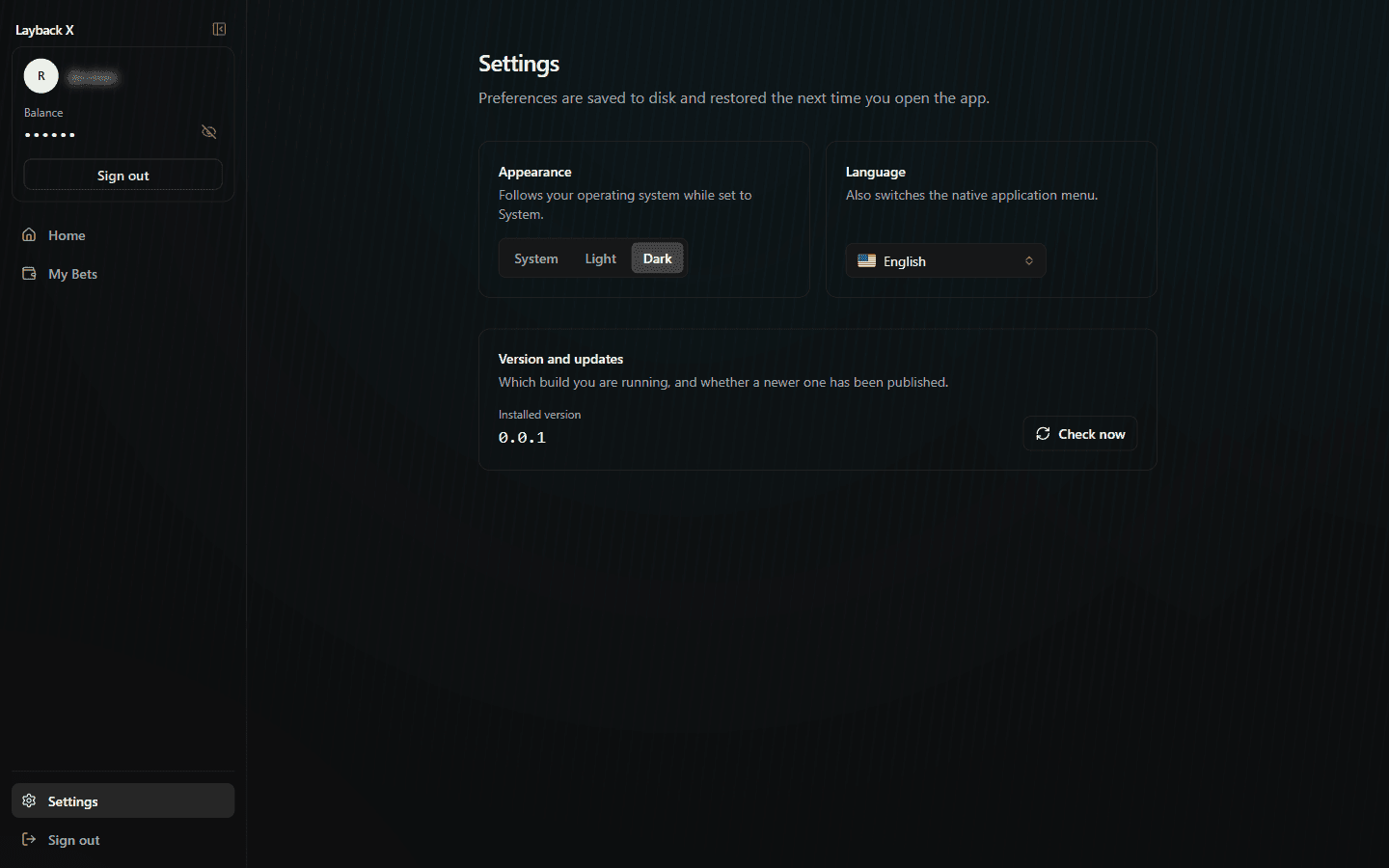
In Settings you choose the appearance (System, Light or Dark, with System following your operating system) and the language, which also switches the app's native menu. Preferences are saved to disk and come back next time you open it.
For screen recording or trading in public, the eye icon in the account panel hides your balance. And the sidebar collapses, giving width back to the ladders.
Glossary
- Bet (order)
- An intent to buy or sell sent to Polymarket at a set odds and amount. My Bets calls it an order; same thing.
- Back
- Betting that the runner happens.
- Lay
- Betting that the runner does not happen.
- Odds
- The price of a share in decimal form. 70¢ is odds 1.43, because 100 ÷ 70 = 1.43.
- Share
- The traded unit: pays 1 USDC if the outcome happens, and 0 if it does not.
- Runner
- Each possible outcome of a market: Home, Draw, Away, Yes, No.
- Stake
- The amount you risk on a bet.
- Liability
- A bet's maximum loss. On a lay bet it grows with the odds.
- Bankroll
- Your total Polymarket account, free money plus money tied up in bets. Available is only the free part.
- Matched / Unmatched
- Matched found a counterparty and became a position. Unmatched is queued and can be cancelled.
- Ladder
- A runner's ladder of odds, with liquidity on each side, traded volume and P&L.
- Weight of money
- The liquidity split between back and lay. Read it as pressure, not probability.
- Cash out
- Closing the position before the result, betting the other way to lock in profit or loss.
- Freebet
- Leaving the position with profit if the runner wins and zero if it loses.
- USDC
- The digital dollar Polymarket settles everything in. One USDC is worth about one dollar.
- Enable trading
- The one-time on-chain authorisation that lets Polymarket's contracts move your wallet's USDC.
- Wallet key
- Your Polymarket account's private key, exported from Magic. Worth as much as your balance. Never share it.